Online business models that actually work in 2026 are the ones that match your skills, fit your budget, and can grow without forcing you into constant hustle. If you want to start an online business, the best path is usually not the flashiest one, it is the one you can keep running long enough to build real momentum.
If you want the shortest path to your first dollars, start with services; if you want the strongest long-term upside, build owned assets like content, email, and digital products.

The best online business models in 2026 tend to share a few traits: low startup cost, clear demand, room to scale, and at least one way to earn recurring revenue. That is why some models are still strong while others look good in theory and then stall in practice.
If you are trying to make money online without getting pulled into random side hustles, this guide will help you compare the main options in a practical way. The goal is not to chase every idea. The goal is to pick one model, build it well, and let it compound.
Key Takeaways
- Start with the model that fits your current budget and time.
- Recurring revenue and owned assets usually beat one-time wins.
- Simplicity and focus matter more than chasing trends.
What Makes an Online Business Model Worth Pursuing in 2026
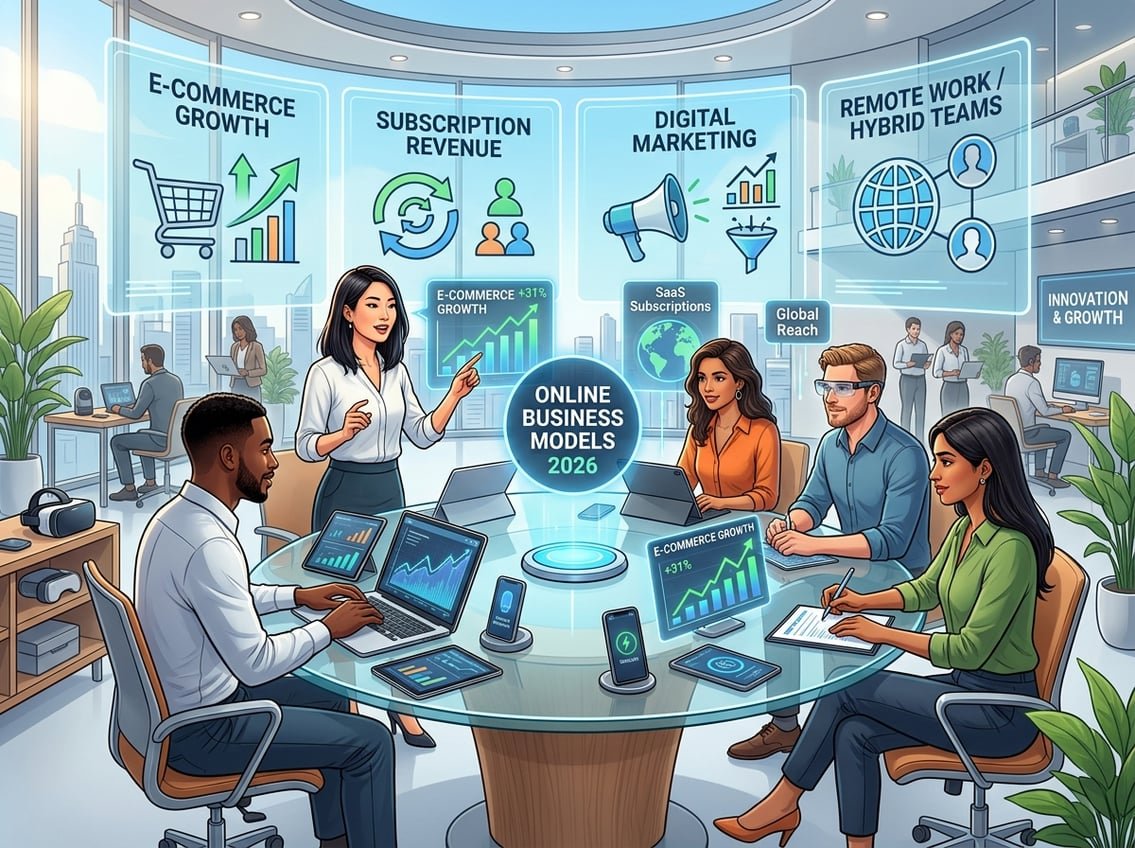
A good model in 2026 is not just about what can make money. It also has to survive rising competition, platform changes, and audience attention shifting fast. That is why startup cost, scalability, and recurring revenue matter so much.
The strongest models give you a clear path from your first sale to a higher monthly earning potential without needing constant reinvention. They also create assets you own, like an email list, website, product library, or client system.
The Core Criteria: Startup Cost, Speed, and Scalability
Startup cost matters because it tells you how long you can stay in the game. A low startup cost gives you room to test ideas without taking big risks, while higher startup costs usually need more proof before you commit.
Speed to income matters too. Freelancing, consulting, and productized services can bring in money faster than blogging or SaaS, while content and software may take longer but can scale better later. In practice, the best choice depends on whether you need cash now or can wait for a stronger income ceiling.
Active Income vs Passive Income vs Recurring Revenue
Active income means you trade time for money, which is common in freelancing, consulting, and coaching. Passive income is often overstated online, because most so-called passive systems still need setup, content, traffic, or support.
Recurring revenue is more realistic and more valuable in many cases. Think memberships, retainers, software subscriptions, newsletters, and SaaS affiliate commissions. According to a 2026 online business model analysis, the lean businesses that win are the ones that compound through recurring revenue, niche authority, and automation.
Why Simplicity and Owned Assets Matter More Than Trends
You do not need the newest trend to build a real business. You need a model you can explain simply, sell clearly, and improve over time.
Owned assets matter because they reduce dependence on one platform. A blog on WordPress, an email list, or a digital product store can keep working even when social media reach drops. That is the same reason iProfitLab keeps pushing simple systems over hype, because stable assets usually age better than attention grabs.
The Best Models for Beginners Who Need a Realistic Starting Point

If you want the most realistic starting point, focus on models that let you learn fast, earn sooner, and build skill with low risk. These options are usually the easiest way to get your first real clients or buyers.
They also teach useful skills like client acquisition, lead generation, sales, and delivery. Those skills transfer well if you later move into affiliate marketing, content, or digital products.
Freelancing and Productized Services
Freelancing is often the fastest way to start. You can offer writing, design, SEO help, editing, or VA work on Upwork, Fiverr, or through direct outreach.
A productized service works even better for many beginners because it has a fixed scope and a clear price. A freelancer can move into retainers once the client trust is there, which makes monthly income more stable. In my experience, simple offers like blog post editing, SEO audits, or short video edits are easier to sell than vague “done for you” promises.
Coaching, Consulting, and Service-Based Businesses
If you already know a skill well, coaching or consulting can work with very low startup costs. You are selling judgment, guidance, and outcomes, not inventory.
This model fits people with experience in marketing, content, operations, sales, or a specific niche. An online coaching offer or consulting package can start as a sole trader setup with just a landing page and a scheduling tool. A practical model ranking puts real market demand, simple offers, and clear sales paths near the top for beginners, which matches what works in the real world.
Social Media Management, Copywriting, and Video Editing
These services stay in demand because businesses need content and attention. Social media management can lead to retainers, copywriting can lead to recurring client work, and video editing is strong if you can serve creators and brands fast.
The main risk is burnout if you take on too many clients too quickly. To avoid that, set clear deliverables and look for repeat work instead of one-off jobs only. A focused offer usually beats trying to be a generalist.
Asset-Based Models That Compound Over Time
Asset-based models take longer to build, yet they often create better long-term income. The reason is simple, you are building something that can keep producing traffic, leads, or sales after the first round of work.
These models fit well if you want to grow beyond active income. They are also a strong match for affiliate marketing, SEO, and email systems.
Blogging, SEO, and Affiliate Sites
Blogging still works in 2026 when you treat it like a business, not a hobby. A focused WordPress site with useful SEO content can build organic traffic over time and earn through affiliate marketing, display ads, or lead generation.
The key is niche authority. When you publish content that solves a narrow problem well, you have a better shot at domain authority and search trust. I have seen the best results come from sites that stay focused on one topic instead of chasing every keyword.
Newsletters, Email Lists, and Recurring Affiliate Income
Newsletters remain strong because email is an owned audience. You are not waiting for algorithm reach, and you can promote useful tools, offers, and content directly.
This is especially strong for recurring affiliate revenue. If you promote SaaS products, newsletter software, or tools with monthly commissions, your list can generate repeat income instead of one-time payouts. Platforms like Beehiiv and similar email tools are popular for this reason, since they support newsletter growth and monetization in one place.
YouTube and Faceless Content Systems
YouTube can work well if you want a content engine with multiple income streams. A channel can earn from ad revenue, sponsorships, affiliate links, and leads to your own products or services.
Faceless content systems are especially useful for beginners who do not want to become the brand face. You can use scripts, AI tools, and simple editing workflows to publish content faster. A lot of creators also pair YouTube with a blog and email list, which gives each piece of content more value over time.
Scalable Digital Product and Software Opportunities
Digital products and software can give you strong profit margins because you are not shipping physical goods. Once the product is built, each sale can cost very little to deliver.
These models work best when you already know a common problem well. Then you package the solution in a way that saves time for the buyer.
Selling Digital Products, Templates, and Ebooks
Digital products are one of the easiest ways to move from service income into asset income. You can sell templates, checklists, swipe files, ebooks, and planning systems through your own site or a marketplace.
A strong digital product business usually starts with a problem you already solve for yourself or clients. Canva templates, content planners, and SEO checklists are common examples because they are easy to explain and easy to buy. The margins are strong, and the workload does not grow much with each sale.
Online Courses, Masterminds, and Knowledge Offers
Online courses still make sense when the result is clear and the audience is specific. If you can teach a repeatable skill, a course can turn your expertise into something scalable.
Masterminds and live knowledge offers work well at a higher price point because they add access and feedback. These models are strongest when paired with a community or email list, since trust matters a lot before someone pays for education. A data-driven review of profitable models highlights courses, newsletters, and services as strong 2026 options for exactly that reason.
Micro-SaaS and AI Automation Businesses
Micro-SaaS is a small software tool built for one narrow problem. AI automation businesses do something similar by helping clients save time with workflows, integrations, and AI tools.
These models have strong scalability and recurring revenue potential, though they usually take more skill to launch. If you can spot repeated pain points in a niche, you may be able to create a simple tool or workflow that people pay for monthly. For beginners, the better path is often to sell automation as a service first, then productize what works.
Ecommerce Models: Which Ones Still Make Sense and Which Are Harder Than They Look
Ecommerce still has a place in 2026, and global ecommerce keeps growing. Even so, some models are much harder than they look once you factor in ads, returns, and margin pressure.
The best ecommerce choice depends on whether you want to hold inventory, use a marketplace, or build your own brand. Each path has trade-offs in setup, speed, and profit margins.
Dropshipping and Print-on-Demand
Dropshipping and print-on-demand can look appealing because startup costs are low. You can launch your store without buying inventory up front, which is why many beginners test these models first.
The hard part is competition and thin margins. Paid traffic can get expensive, product research takes time, and customer service is still your problem. These models can work, yet they usually need strong positioning, good creatives, and careful testing. If you want a quick store setup, a platform like Shopify is common, while some sellers also use services like Sellvia or even a free store offer to get started faster.
Amazon FBA, Etsy, eBay, and Marketplace Selling
Marketplaces can help you borrow trust and traffic. Amazon FBA gives access to a large buying audience, Etsy works well for handmade and niche items, and eBay can still move used or collectible goods.
The trade-off is dependence on platform rules. You may get faster sales, yet you own less of the customer relationship. That makes marketplaces useful for testing demand, though not always the best long-term base for your whole business.
Inventory, Fulfillment, and Margin Trade-Offs
Physical products always bring more complexity. You need product research, inventory planning, fulfillment, returns, and sometimes customer support that never ends.
That does not mean ecommerce is bad. It means you should know the real work before you launch your store. In many cases, a service business, affiliate site, or digital product business gives you a cleaner path to profit margins and less operational stress.
How to Choose the Right Path and Build a Simple Growth System
The right choice depends on your starting point, not just your goals. If your budget is tight, your best online business ideas will look very different from someone who already has experience, traffic, or capital.
The smartest path is usually to begin with the simplest model that can earn soon, then shift into compounding assets once you have traction.
Match the Model to Your Skills, Budget, and Time
If you have little money and some skill, services are a strong starting point. If you like writing, blogging and affiliate marketing may fit better. If you are comfortable on camera or behind the scenes, YouTube or faceless content can work well.
Niche selection matters too. Choose a niche where people already spend money, where you have some real interest, and where you can create useful content or offers. Social platforms like TikTok and Instagram can help with reach, yet they work best as traffic sources, not the only home for your business.
A Smart Progression: Cash-Flow First, Then Compounding Assets
A practical growth path often looks like this, service first, content next, email next, products later. That gives you cash flow while you build something that can scale beyond your hours.
For example, you might start with copywriting or SEO help, then turn your best work into blog content, an email list, and a digital product. Affiliate marketing can fit in at the same time, especially if you promote tools you already use. That is the kind of system iProfitLab focuses on, because it reduces chaos and increases the chance that each effort keeps paying you later.
Tools and Platforms That Support Long-Term Growth
You do not need a huge stack of tools. A simple setup can include WordPress for your site, Mailchimp or Beehiiv for email, Later for content scheduling, and a few AI tools for research or drafting.
Automation should save you time, not create more clutter. Use it for content creation support, email workflows, and repeat tasks. If you want a clean starting point, the Free AI Income Starter Kit and the Recommended Tools page are useful next steps because they keep the focus on systems that support recurring revenue and long-term growth.
Frequently Asked Questions
What are the most profitable online business ideas to start in 2026 with a realistic budget?
The most realistic profitable ideas usually include freelancing, productized services, affiliate blogging, newsletters, and digital products. These models keep startup costs low and let you test demand before you spend much. If you have more technical skill, micro-SaaS and AI automation can offer higher upside.
Which online business models are trending in 2026, and what’s driving their growth?
Recurring models are getting the most attention, especially newsletters, SaaS, memberships, and niche content sites. They are growing because creators and buyers both want systems that keep working after the first sale. A recent comparison of profitable models points to newsletters, courses, ecommerce, and SaaS as strong 2026 choices.
What online businesses can beginners run from home in 2026 without a large audience?
You can start freelancing, copywriting, video editing, social media management, or consulting from home with little audience size. You can also build a blog, newsletter, or digital product store while your audience grows. The key is to choose a model that does not depend on having a big following on day one.
How can I validate an online business idea in 2026 before investing time and money?
Start by checking whether people already pay for the problem you want to solve. Look at competitor offers, search demand, affiliate programs, marketplace listings, and community discussions. If you can find clear demand and a simple offer, that is a stronger sign than a clever idea with no buyers.
What AI-powered online business opportunities are viable in 2026 without deep technical skills?
Useful options include AI-assisted content creation, faceless video workflows, automation services, and niche digital products. You do not need deep technical skills to use AI tools for outlines, drafts, research, or workflow support. The real value comes from your niche judgment and your ability to package a useful result.
How do I choose between ecommerce, digital products, services, and subscriptions when starting online in 2026?
Choose services if you want fast cash flow and low startup cost. Choose digital products or subscriptions if you want better scalability and recurring revenue. Ecommerce can work too, yet it usually asks for more operational effort, so it makes the most sense when you want a product brand and can handle inventory or fulfillment trade-offs.